
A law lecturer argues that moving the UN out of the USA would cut costs, and promote greater support and participation from the Global South.
Origin of the UN
During World War I, world leaders advocated for a world body in an attempt to ensure peace.
Shortly after the war, in 1920, the League of Nations was established with the ratification by 42 nations, and four permanent members: the United Kingdom, France, Italy and Japan. Despite the initial backing of US president Woodrow Wilson, the USA did not join the League.
The League proved to be ineffective.
In particular, it failed to act or stop the 1933 Japanese invasion of Manchuria (northeast China). Forty nations voted for Japan to withdraw but Japan voted against it and instead left the League.
Similarly, it failed to prevent the 1935 Second Italo-Ethiopian War. Italy and other nations left the League. It also failed to avert World War II.
The UN Security Council
During WWII, the Arcadia Conference was held in Washington DC, USA, between US president Roosevelt and UK prime minister Churchill.
The Declaration by United Nations was drafted in late 1941 by Roosevelt, Churchill, and Harry Hopkins, a deputy to president Roosevelt, and signed in early 1942 by the USA, UK, USSR (Soviet Union, now Russia) and China – the four major Allied countries in the war, referred to by Roosevelt as the “Four Policemen” – and by 22 other nations.
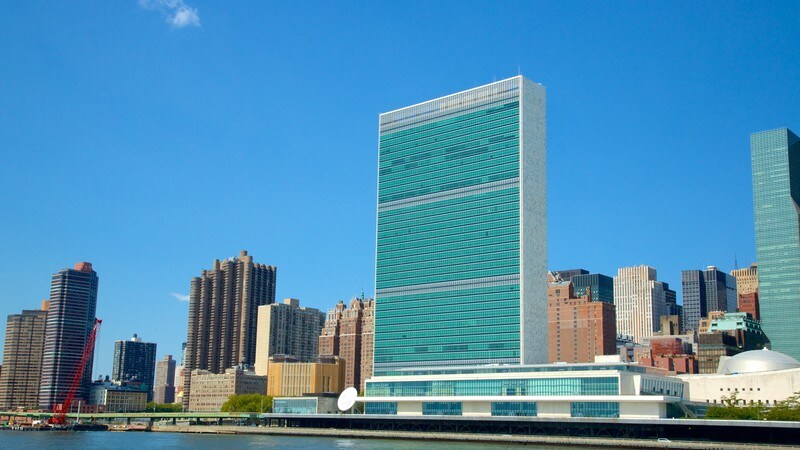
Source: Tourism Media
The United Nations headquarters is in New York City, USA, where all its principal organs are located, apart from the International Court of Justice. It also has other offices in Geneva (Switzerland), Nairobi (Kenya), Vienna (Austria), and The Hague (The Netherlands), where the ICJ is.
The four policemen, along with France, eventually became the permanent members of the UN Security Council.
The permanent members have veto power, that is:
Under Article 27 of the UN Charter, Security Council decisions on all substantive matters require the affirmative votes of nine (i.e. three-fifths) of the members. A negative vote or a "veto" by a permanent member prevents adoption of a proposal, even if it has received the required votes.
This puts enormous power into the hands of five out of the 193 nations of the world.
The power of veto (mostly individually, and sometimes alongside other members) has been used throughout the life of the Security Council.
France has used the veto 11 times, China 19 times (mostly since 1997 alongside Russia), and the UK 24 times (but not since 1989).
The overwhelming use of the veto has been by the USA (80 times, mostly regarding the situation in the Middle East, especially Palestine and Lebanon) and Russia (as the USSR up to 1984, 68 times, and as Russia, 39 times).
The most recent veto that was not exercised by the USA or Russia (Russia often alongside China) was in 1999.
The Global North and South
The structure of the UN, especially the Security Council, is seen by many as the division between the so-called Global North and South.
This is not a strict geographical hemisphere division as, for instance, Australia and New Zealand are both classified in the Global North, and China in the Global South.
Rather, it relates to developed versus underdeveloped countries. The Global North comprises Northern America, Europe, Israel, Japan, South Korea, Australia, and New Zealand.
The power of veto by the Security Council’s five permanent members means that the Global South has little influence over its decisions, despite being by far more populous than the Global North.
During the current Israeli War on Palestine, it means that, despite widespread criticism, demonstrations and boycotts around the world, any resolution censuring Israel for its genocide is regularly vetoed by the USA, and thus not passed.
A new world order
These problems with the United Nations have led to some commentators suggesting that substantial changes need to be made to the body.
In an opinion piece in Al-Jazeera, Shahd Hammouri, Lecturer in International Law at the University of Kent, lists many of the snubs given by Israel and the USA towards the UN.
Israel has:
• killed UN workers
• banned UNRWA
• barred UN representatives from entry
• repeatedly insulted the UN and its officials
• exerted pressure on the International Criminal Court (ICC) not to investigate Israeli crimes
Similarly, US president Trump has:
• signed an executive order reintroducing sanctions on ICC staff members
• flaunted his complete disregard for international law by declaring his intention to “take over” Gaza and “own it”
Hammouri concludes that the status quo is a major world problem. “All of these developments raise questions about whether the current global system led by the UN is beyond salvation.”
She points out that, at the establishment of the UN after WWII, Chilean legal scholar Alejandro Alvarez argued that the European legal tradition, on which much of international law was based, was inadequate to address legal questions in places like South and Central America (in the Global South).
Instead, he proposed a “new international law” which accommodated the particular historical moment of the decolonisation across the world, and reflected the interests and positions of decolonised states.
Global South nations have already proposed that Israel should be removed from the UN. A petition to this effect, signed by 500 legal scholars worldwide, has also been submitted to the UN General Assembly.
In response, the US Congress sent a letter to the UN Secretary Antonio Guterres threatening to withdraw US funding if such a vote were to go ahead.
If this happens, Hammouri proposes a simple solution: move the UN outside the US to somewhere in the Global South. Arguments for this are that it would:
• drastically cut costs
• promote Global South support
• enable stronger participation from the Global South
In her final summary, Hammouri hits the nail on the head: “It would do away with the dilemma of an international legal institution headquartered in a state [the USA] that has proven to be the most consistent perpetrator of the crimes that the institution was created to prevent.”


Leave a Comment
Your email address will not be published. Required fields are marked with *